
Feature guide · Solve mode
Whole-board problems: training the skill you actually use
Ask a strong player what a weaker player should practise and the answer is almost always tsumego — life-and-death problems. They are the oldest, best organised training material in Go, and they do sharpen reading. But think about what a tsumego actually asks you: a corner shape is already isolated, the boundary is already drawn, and you have been told in advance that something is there to be killed or saved. All that is left is to read it out.
In a real game, nobody hands you that frame. Counting generously, the moves where a self-contained life-and-death problem decides the outcome amount to a small slice of a game — a handful of moves out of two hundred. The rest of the time you are facing a very different question, and you face it every single move:
Extend here or take the big point there? Answer the attachment, or tenuki and take the last open corner? Push once more, or is that already the move that loses a tempo? That judgement — direction of play, urgency, the relative size of two areas twenty lines apart — is what you spend the game doing. It is also the thing almost nobody practises deliberately, because until recently there was no answer key for it. A corner problem has a provably correct answer. "Which of these five big points is best?" used to be a matter of opinion.
A strong engine changes that. So TensuGo built the training around it.
Try whole-board problems now → In your browser · No install · No account needed
What a whole-board problem looks like
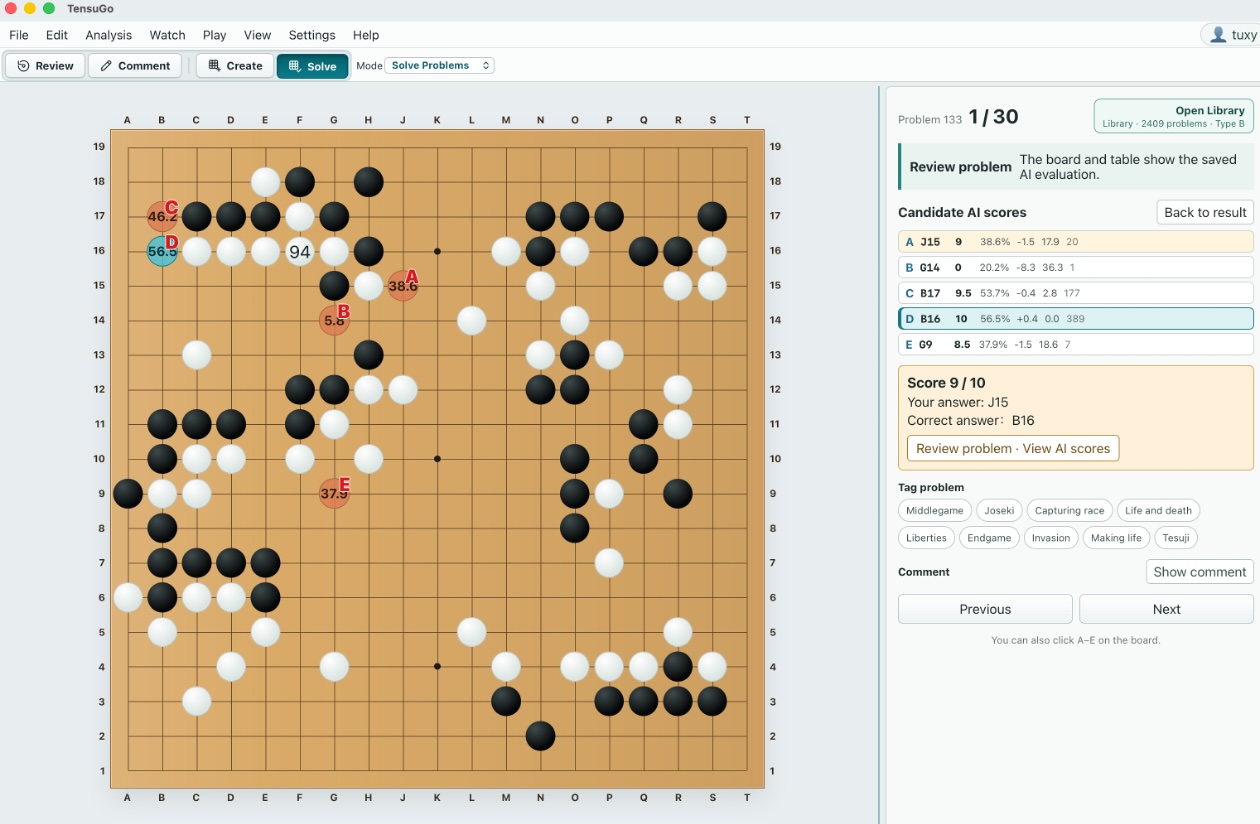
You are given a whole position — a real one, taken from a real game, at a real moment where the choice mattered. Between two and five candidate points are marked on the board as A, B, C, D, E. Your job is to pick the best one. Click a letter on the board, or the option in the list.
The moment you answer, the panel opens up and shows the engine's full read of every candidate, not just the one you picked:
- Score — how much of the problem's credit that move earns, out of 10.
- Win rate — the engine's winning probability after that move.
- Score lead — points ahead or behind, which often tells you more than the win rate does.
- Loss against the best move — the cost of the move you chose, in points.
- Visits — how hard the engine looked at that move, so you can tell a confident verdict from a close call.
In the example above the answer given was J15 and the best move was B16 — but J15 still scored 9 out of 10. That is deliberate. Whole-board judgement is not a pass/fail skill. Two big points can be worth almost the same thing, and a system that calls the second-best move simply "wrong" teaches you nothing except to distrust it. Partial credit is the honest answer, and it is also the more useful one: a 9/10 tells you your instinct was sound; a 2/10 tells you your whole reading of the position was off.
Why the scores can be trusted
Every problem in the library was created by running a full KataGo analysis over the position and storing the result. The candidate list, the win rates, the score leads and the ranking are all the engine's, saved with the problem — so reviewing a problem later shows you exactly the same numbers, and the scoring is identical for everyone.
One rule TensuGo holds to: in solve mode, live analysis is refused. You cannot start the engine on a problem you are answering, and entering solve mode with analysis already running turns it off. The engine's read is the answer key, and a key you can peek at is not training.
The library
- 2,409 problems in the bank at the time of writing, drawn from real games — and growing.
- Difficulty is derived, not declared. There are no player ranks attached to these positions. A problem's difficulty comes from the engine's own numbers — how close the candidates are to each other, how much a mistake costs — and is banded by percentile, so every band stays populated and the levels mean something relative to the whole library.
- Problems are spread across source games. Consecutive positions from one game would test the same idea five times; a draw always reaches across different games.
- Your own games become problems. Any position you have reviewed in TensuGo can be turned into a problem with its analysis attached — which means the turning point you got wrong on Tuesday can be the thing you practise on Friday.
Practice, not just problems
A problem you got wrong once and never saw again taught you nothing. Solve mode keeps track:
- Sets with a shape. Work through a numbered set — 1 / 30, 2 / 30 — rather than an endless stream, so a session has an end and a result.
- Spaced repetition. Problems you missed come back on a schedule, and stop coming back once you have genuinely learned them.
- Tags. Middlegame, joseki, capturing race, life and death, liberties, endgame, invasion, making life, tesuji — tag as you go, and your mistakes become a map of what to study.
- Your own comments. Write down why you picked what you picked. On the revisit, that sentence is worth more than the score.
Share a set as a link
The same problems work outside the desktop app. TensuGo can generate a share link that opens in any browser, phone included, with no installation and no account — a set of whole-board problems, optionally on a clock, with a public leaderboard for everyone who tries it. It is the fastest way to show a clubmate what this kind of training feels like.
The short version
Life-and-death problems train reading inside a box someone else drew for you. Whole-board problems train the thing you do on every move of every game: looking at the entire board and deciding where the game is right now. Until an engine could grade that judgement, it could only be learned slowly, from losing. Now it can be practised directly — with a score, a reason, and a record of what you keep getting wrong.
Solve in your browser Download TensuGo All feature guides
Free · Windows & macOS · No account required to start